

Support CleanTechnica's work through a Substack subscription or on Stripe.
Originally published on ilsr.org.
Register now for our webinar based on our newly-released report, Beyond Sharing: How Communities Can Take Ownership of Renewable Power. If you’re interested in attending on Wednesday, May 11 (at 11AM CST) or want to receive a copy of the presentation, register here.

Read the full report: Beyond Sharing — How Communities Can Take Ownership of Renewable Power
U.S. Barriers to Community Renewable Energy
Three major barriers still inhibit widespread expansion of community renewable energy, much as they did when ILSR published its community solar report in 2010.
- Federal and state securities laws, meant to shield ordinary people from Ponzi schemes and bad investments, are often too onerous for community-scale renewable energy projects.
- Federal tax incentives require specific and sufficient tax liability, in ways that often precludes ordinary community investors.
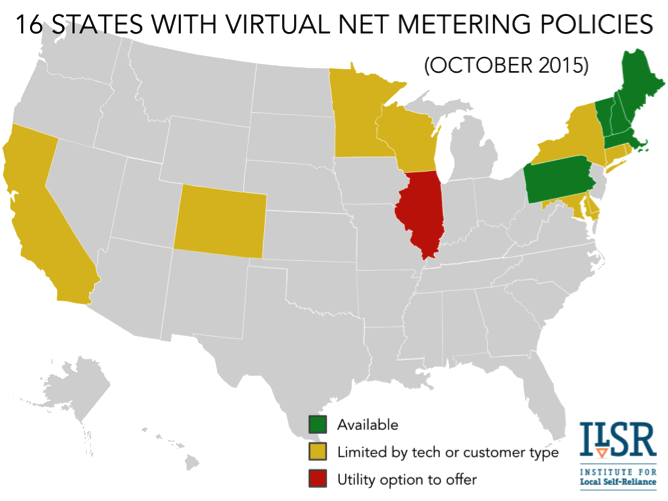
- Finally, legal limitations to sharing electricity output from community-based renewable energy projects mean only states with explicit exemptions are likely to see substantial growth in community renewables.

Busting the Barriers?
Within limits, policy makers have found ways to work around or reduce the barriers to community renewable energy, but their solutions haven’t yet proven widely scalable without significant compromise.
- State and federal crowd funding laws have carved out exemptions from securities limitations, although the laws remain substantially complex and compliance is expensive.
- Successful community renewable energy projects have found third party “tax equity” partners to provide access to a fraction of the tax incentives, but far less than if they could have captured the incentives themselves. The long-term phase out of federal renewable energy incentives (and potential substitution of low-cost capital) may finally address the incentive inequity between community-based and single-party, for-profit projects.
- Shared solar typically has third party or utility owners of community-based projects with participation limited to compensation via electric bill credits. In this manner, the third party or utility allows shared solar to overcome the securities and tax incentive barriers. Although proven to be the most replicable, shared solar usually requires a sacrifice of community ownership and control. Additionally, some utility-run programs may offer poor payback or be designed to divert customers from individual solar ownership.
- Cooperatives, very popular in the grocery and agriculture industry, solve the securities barrier by allowing unlimited fundraising from members and retain economic benefits for member-owners. A promising solution, cooperatives may face the same challenges (i.e. access to federal tax incentives) as other community-based institutions.
Exceptional Community Renewable Energy Projects
Despite the barriers, a number of clever entrepreneurs have pulled together community renewable energy projects that combine local, community-scale renewable energy and local ownership. Selected examples from the report include:
- A 35-member LLC in University Park Maryland installed a community solar array on a local church
- Nearly 200 Iowa rural residents financed 6 community-owned turbines
- Over 600 South Dakota residents are owners in a 7-turbine wind power project hosted by Basin Electric Cooperative
Cities as “Community”
More than 2,000 cities have municipal electric utilities. Cities with municipal utilities like Georgetown or Denton, Texas, have already signed contracts for 70 to 100% renewable electricity. Many more cities have pooled their resources to procure renewable energy in joint ventures. In a few states, municipalities are able to make clean energy procurement a priority via “local energy aggregation,” and two California aggregations, Marin Clean Energy and Sonoma Clean Power, already offer electricity at competitive prices with a higher portion of renewable energy than incumbent utilities.
A Community Renewable Energy Gold Standard
There are four key principles to successful and meaningful community renewable energy:
- Tangible benefits for participants
- Flexibility of ownership structure
- Additive to other renewable energy policies
- Access for all
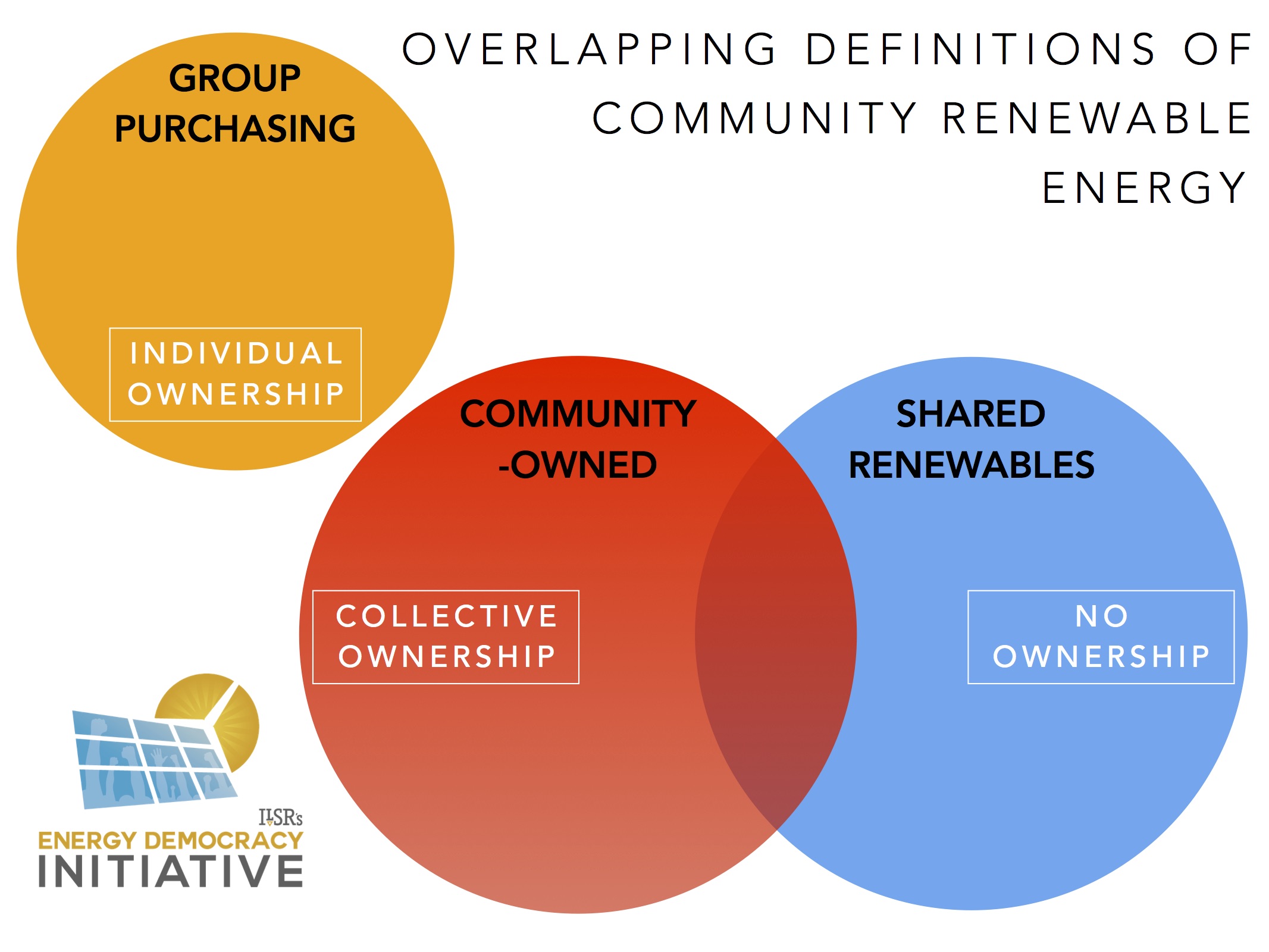
While these principles apply to all community renewable energy, ILSR prioritizes community-owned renewable energy, in particular, for its greater economic benefits and local control. As is shown below, community-ownership may be distinct from shared solar, or from collective action that supports individual ownership, such as group purchasing. Some examples of the three categories are shown in the full report.
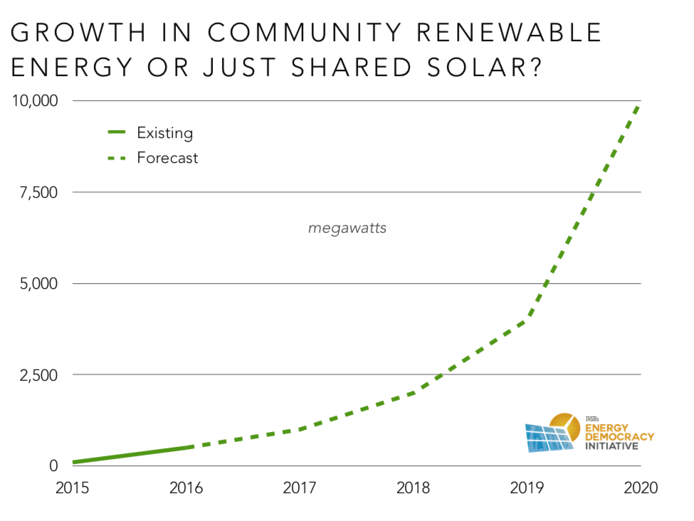
Shared renewables have led the development of community renewable energy and the forecasts for growth because it bypasses two of the most significant barriers, securities regulation and access to tax incentives. But proponents of community renewable energy should look beyond sharing. Ownership allows local decision making about location, hiring, and participation that shared solar may not, and it will require all forms of community renewable energy to make it as ubiquitous in the 21st century as utility ownership was in the 20th.
For timely updates, follow John Farrell on Twitter or get the Democratic Energy weekly update.
Sign up for CleanTechnica's Weekly Substack for Zach and Scott's in-depth analyses and high level summaries, sign up for our daily newsletter, and follow us on Google News!
Have a tip for CleanTechnica? Want to advertise? Want to suggest a guest for our CleanTech Talk podcast? Contact us here.
Sign up for our daily newsletter for 15 new cleantech stories a day. Or sign up for our weekly one on top stories of the week if daily is too frequent.

CleanTechnica uses affiliate links. See our policy here.
CleanTechnica's Comment Policy