


Support CleanTechnica's work through a Substack subscription or on Stripe.
Kestrel Supercomputer Advanced More Than 500 Energy Modeling and Simulation Projects
By Julia Medeiros Coad
The National Laboratory of the Rockies’ (NLR’s) advanced computing capabilities continue to grow with the demands and complexities of applied energy research, with key upgrades to the laboratory’s Kestrel supercomputer supporting hundreds of projects with dozens of collaborators in 2025.
NLR’s Fiscal Year 2025 Advanced Computing Annual Report shows how the laboratory’s high-performance computing, artificial intelligence (AI), and modeling capabilities contribute to U.S. Department of Energy (DOE) programs and can boost scientific discovery across the laboratory’s research portfolio.
NLR’s high-performance computing system—Kestrel—and other resources, including hybrid cloud computing, helped advance more than 500 modeling and simulation projects and supported 800-plus users who produced more than 700 technical outputs, including 293 peer-reviewed publications in Fiscal Year 2025. These outputs progressed work in materials science, integrated energy systems, manufacturing, fluid dynamics, and more.
“This year’s report highlights the growing importance and benefit of AI throughout applied energy research and features work by early-career researchers who are helping shape the future of computing-enabled energy innovation,” said Kris Munch, NLR’s program manager for Advanced Computing.
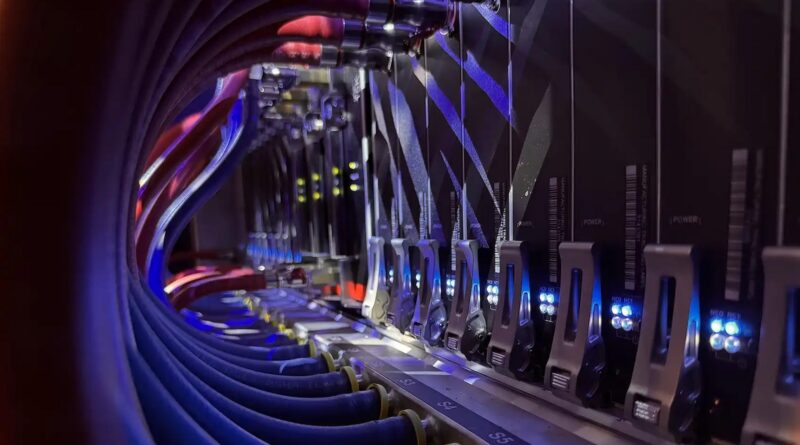
NLR’s Kestrel supercomputer received a set of capability upgrades for Fiscal Year 2025, expanding performance and capacity to better meet the demands of AI-enabled research. These enhancements included upgrades to two central processing unit racks and expansion of Kestrel’s graphics processing unit resources, boosting throughput for emerging AI and machine-learning workflows, such as large model training and surrogate modeling. Memory capacity was also expanded on a targeted subset of central processing unit and graphics processing unit nodes, enabling researchers to tackle larger models, higher-resolution datasets, and more complex systems.
Efforts featured in the annual report include projects that discover new materials, optimize industrial reactors, and improve energy system planning:
- NLR’s ElectroCat modeling team uses machine learning powered by Kestrel to explore cost-effective and scalable alternatives for scarce and costly metals used in battery and energy storage technologies. This effort can speed up screening of critical-mineral-free electrocatalysts and help to identify efficient, durable, and inexpensive options.
- The BioReactorDesign open-source modeling tool allows new bioreactor designs to be tested and optimized virtually before they are built. Using accurate, computationally efficient predictions of gas-liquid flow behavior, this modeling effort aims to reduce the risks and costs of traditional bioreactor scaleup.
- NLR’s demand-side grid (dsgrid) team uses sector-specific energy modeling expertise to understand current and future U.S. electricity load for power systems planning. Researchers are further developing the dsgrid toolkit by linking to other DOE models to project high-resolution electricity load scenarios, seeking to strengthen region-specific planning and improve whole-economy analysis.
Explore the Fiscal Year 2025 Advanced Computing Annual Report highlights or download the full report to learn more about how NLR’s advanced computing capabilities enable researchers to tackle complex energy challenges and facilitate scientific discovery for real-world applications.
Article from NLR.
Sign up for CleanTechnica's Weekly Substack for Zach and Scott's in-depth analyses and high level summaries, sign up for our daily newsletter, and follow us on Google News!
Have a tip for CleanTechnica? Want to advertise? Want to suggest a guest for our CleanTech Talk podcast? Contact us here.
Sign up for our daily newsletter for 15 new cleantech stories a day. Or sign up for our weekly one on top stories of the week if daily is too frequent.

CleanTechnica uses affiliate links. See our policy here.
CleanTechnica's Comment Policy