



Support CleanTechnica's work through a Substack subscription or on Stripe.
The foodservice industry is notoriously difficult to decarbonize, especially when it comes to water heating. From quick-service chains to grocery stores and fine dining, each subsector has its own challenges, from volatile draw profiles (how much water a site uses each day and when) to a lack of airflow or available space for efficient heat pump water heaters (HPWHs). In our field research, we’ve identified three key factors that influence how efficiently HPWHs run in foodservice settings, including hot water demand, ambient air temperature near the water heater, and whether the site uses continuous recirculation.
Small Commercial HPWH Field Research
As of 2026, most foodservice sites are served by inefficient electric resistance or gas water heaters. The former adds thousands of dollars a year to utility bills; the latter raises kitchen temperatures and releases local and planet polluting gases, including nitrous oxides (N2O), methane (CH4), and, of course, carbon dioxide (CO2).
Heat pump replacements already exist and have been installed in the field, but up until now, real-world performance data has been sparse. The Advanced Water Heating Initiative (AWHI) set out to understand how HPWHs are performing in small commercial buildings by conducting the first comprehensive field study of the technology. We wanted to see how these systems are performing and what strategies and configurations could help them perform better.

We’re excited to share interim performance data from six sites in California and Texas, including three quick-service restaurants, two grocery stores, and a sit-down restaurant. All sites have either an integrated 120-gallon tank heat pump water heater or a split system heat pump with an indoor tank. Below are three factors that influence how efficiently small commercial HPWHs are performing in the foodservice industry.
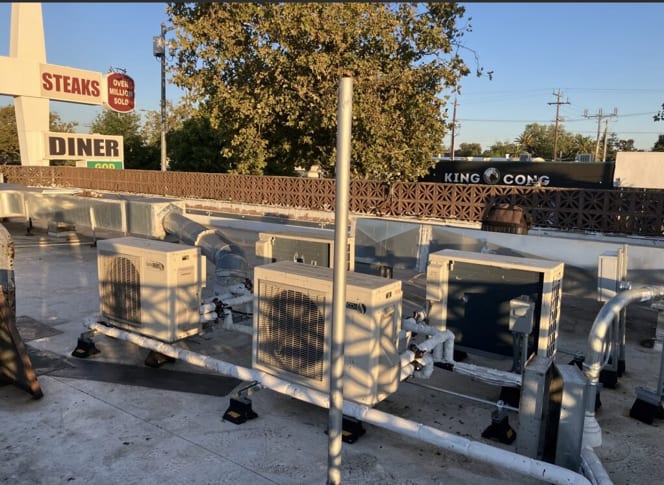
Draw profiles — how much water a site uses (and when)
First, let’s look at draw profiles for each site, which show daily hot water consumption in gallons. Each blue bar shows how often (number of days) a site drew a given number of gallons.
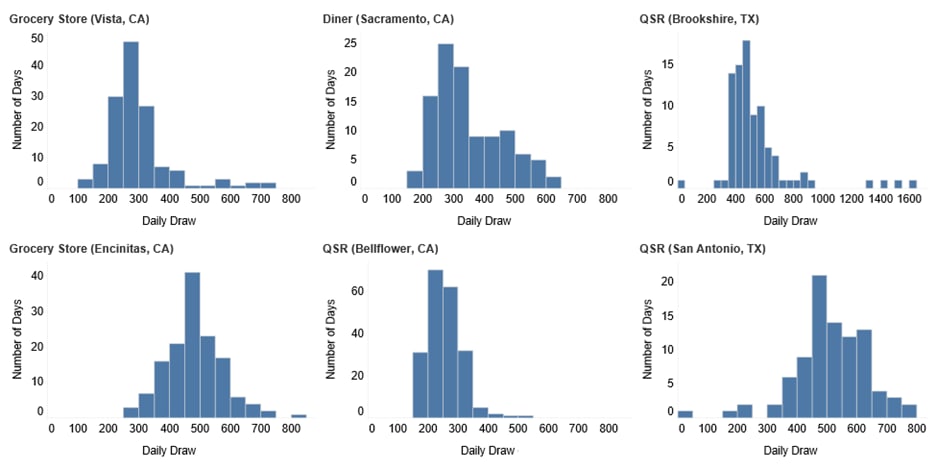
As you can see, inter-day variability is extremely high. High-draw days are frequently 500 gallons above low-draw days, even accounting for weekends/closures. This inconsistency can make sizing a heat pump tricky: You want to ensure the peak draws are met, but oversizing a system means higher first costs. On the other hand, under-sizing means relying on backup elements, which tanks the efficiency (pun intended).
Speaking of backup element use, that also varied significantly between sites with the integrated units. The table below details electric resistance element use as a fraction of total energy used for hot water production.

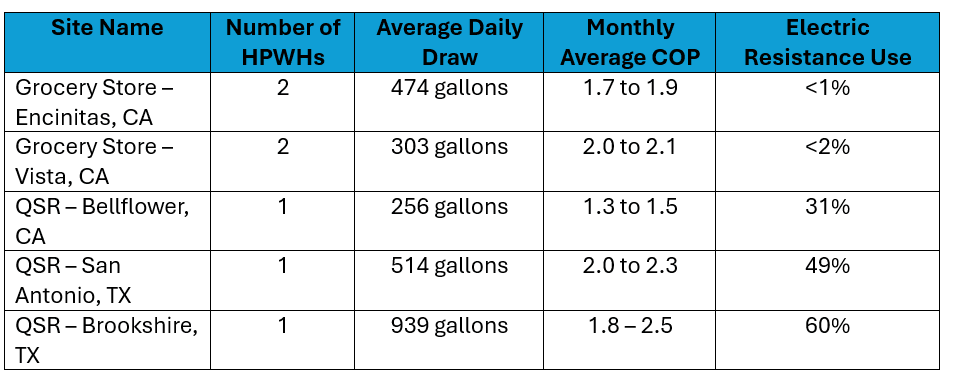
It’s a small sample size, but especially for the QSRs, we can clearly see electric resistance use rise with hot water consumption. Both grocery sites are adjacent to refrigeration equipment, which produced significant waste heat; it’s possible that extra heat minimized resistance element use. The diner has a split system with no resistance elements and therefore isn’t listed in the table above.
Ambient temperature
Next, let’s look at ambient temperature and its effect on the coefficient of performance (COP), where a COP of 1 means a water heater is 100% efficient.
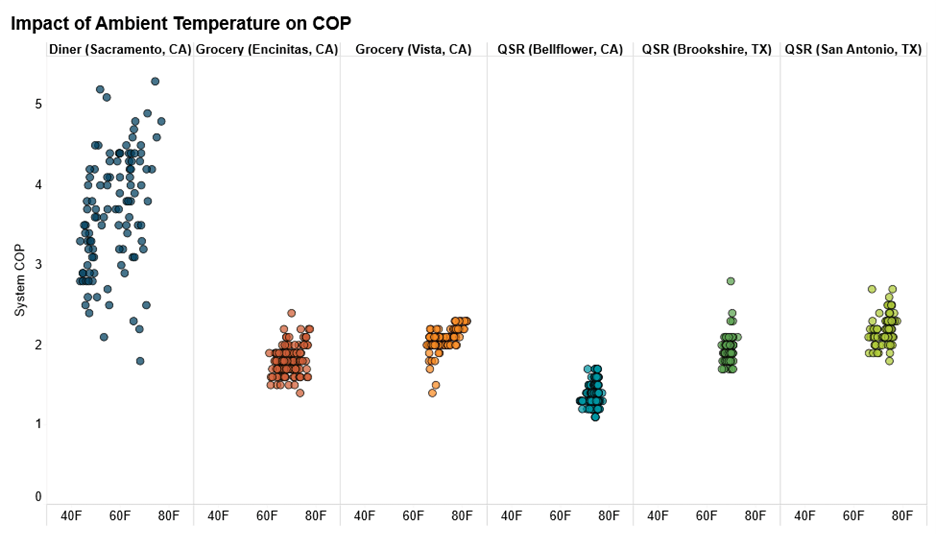
There is certainly correlation between higher ambient temperatures and better performance for the grocery stores and the diner. The highest COP days happen around 80°F, for the most part. However, the overall trend is weak (low R-value), suggesting there are many factors at play when it comes to efficiency.
Recirculation Pumps
Perhaps the most important variable, at least for integrated HPWHs, is whether the recirculation pump is controlled based on a set point and/or timer. Looking at the chart below, see if you can spot which QSR site had uncontrolled recirculation:
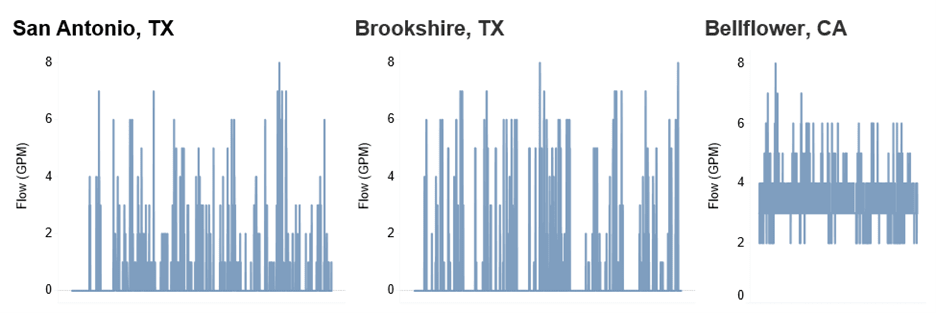
The answer: Bellflower. Each plot above represents one week of minute-by-minute hot water flow. The Bellflower site never reaches 0 gallons per minute, indicating that the recirculation pump is always running. Sure enough, Bellflower also has the lowest COP. Uncontrolled recirculation diminishes HPWH efficiency, because the return water is always almost as hot as the outlet water. Integrated HPWHs work best when they receive cold city water. Therefore, such a small delta (temperature difference) between inlet and outlet drastically reduces system performance.
How much water a site uses, the temperature around the heat pump, and the recirculation pumps all influence how efficient small commercial HPWHs are, with the pumps being perhaps the most important factor. This sample of sites is only a small subset of AWHI’s Small Commercial HPWH Field Study. Our final report will include analysis of 26 total sites, ranging from ministries to offices and even a climbing gym. Stay tuned!
By Noah Gabriel, New Buildings Institute
Sign up for CleanTechnica's Weekly Substack for Zach and Scott's in-depth analyses and high level summaries, sign up for our daily newsletter, and follow us on Google News!
Have a tip for CleanTechnica? Want to advertise? Want to suggest a guest for our CleanTech Talk podcast? Contact us here.
Sign up for our daily newsletter for 15 new cleantech stories a day. Or sign up for our weekly one on top stories of the week if daily is too frequent.

CleanTechnica uses affiliate links. See our policy here.
CleanTechnica's Comment Policy