


Support CleanTechnica's work through a Substack subscription or on Stripe.
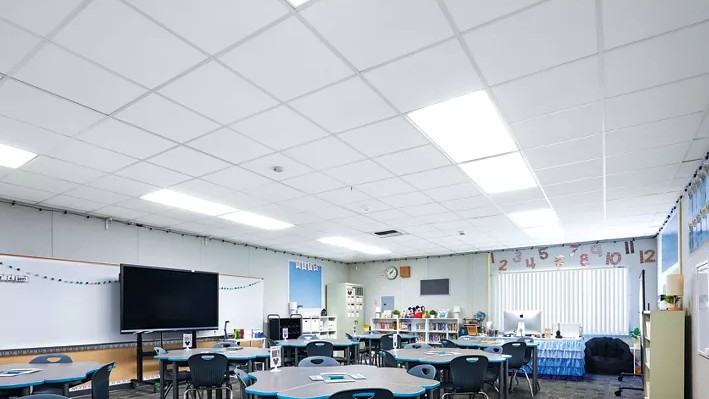
While exploring the exhibits at the New York Build Expo, I came across the Armstrong booth. Initially, nothing particularly interesting stood out. It just looked like traditional acoustic ceiling tiles. However, I asked if they had anything new and relevant to clean technology, and they pointed me to their new Templok ceiling tiles with integrated phase change material. Overall, they do not draw attention to themselves or require complicated systems to work, but they can provide useable thermal energy storage.

The Phase Change Material (PCM) in Templok ceiling tiles absorbs heat as it becomes a liquid and releases heat as it solidifies — in this case, through the process of dissolution/crystallization, rather than melting/freezing. The material uses a salt-based solution within a metallized polymer pouch.

Overall, it doesn’t look like much — just a pouch of a few millimeters thickness on the back of a normal looking ceiling tile. However, according to Armstrong, one lightweight ceiling panel has the same effective thermal mass as 11 bricks. If you put your hand up against a solid part of the material, you can feel it absorbing heat, but it doesn’t feel uncomfortably cold. The PCM material also has a benefit in that the phase change happens over a limited temperature range. The material can be formulated to release or absorb heat at room temperature. As such, it can passively moderate temperature over a large surface while resisting the formation of condensation that would happen with a lower temperature over less surface area. In addition, the heat absorbed/released in the material means less is lost during ventilation.
Templok is designed to have its phase change occur at room temperature. As heat rises, the ceiling will be warmer than the floor. However, a suspended ceiling tile also acts like an insulated partition between the conditioned air below it and the air space above it. The temperature fluctuation will tend to be greater above the tile than what people experience within the room, especially if the building roof is above the ceiling tile.
As the phase change material cannot be cut, cosmetically identical ceiling tiles without the phase change material are used for edges and tiles that have holes for sprinklers, lights, speakers, etc. As such, the system works with roughly ⅔ of the ceiling tiles containing PCM.
Overall, the ceiling tile system is projected to save energy costs by up to 15%. That might not sound like a massive number to some people, but we are dealing with large energy bills with commercial HVAC. The costs add up quickly. The performance will clearly depend heavily on the circumstances. During some times of day, the reduction in electricity use would be greater. If the tile is kept at a steady temperature, then little heat will be stored and released by the phase change material and the benefit would be minimal. If the temperature changes at the tile (air space above it and/or at ceiling height), then it can provide a benefit, even if the temperature at floor level stays relatively constant. In desert environments, with hot days and cold nights, the overall difference could be significant. For buildings with set operating hours, the off-hour times can also lead to temperature fluctuations. The following example comes from a school in a desert location:
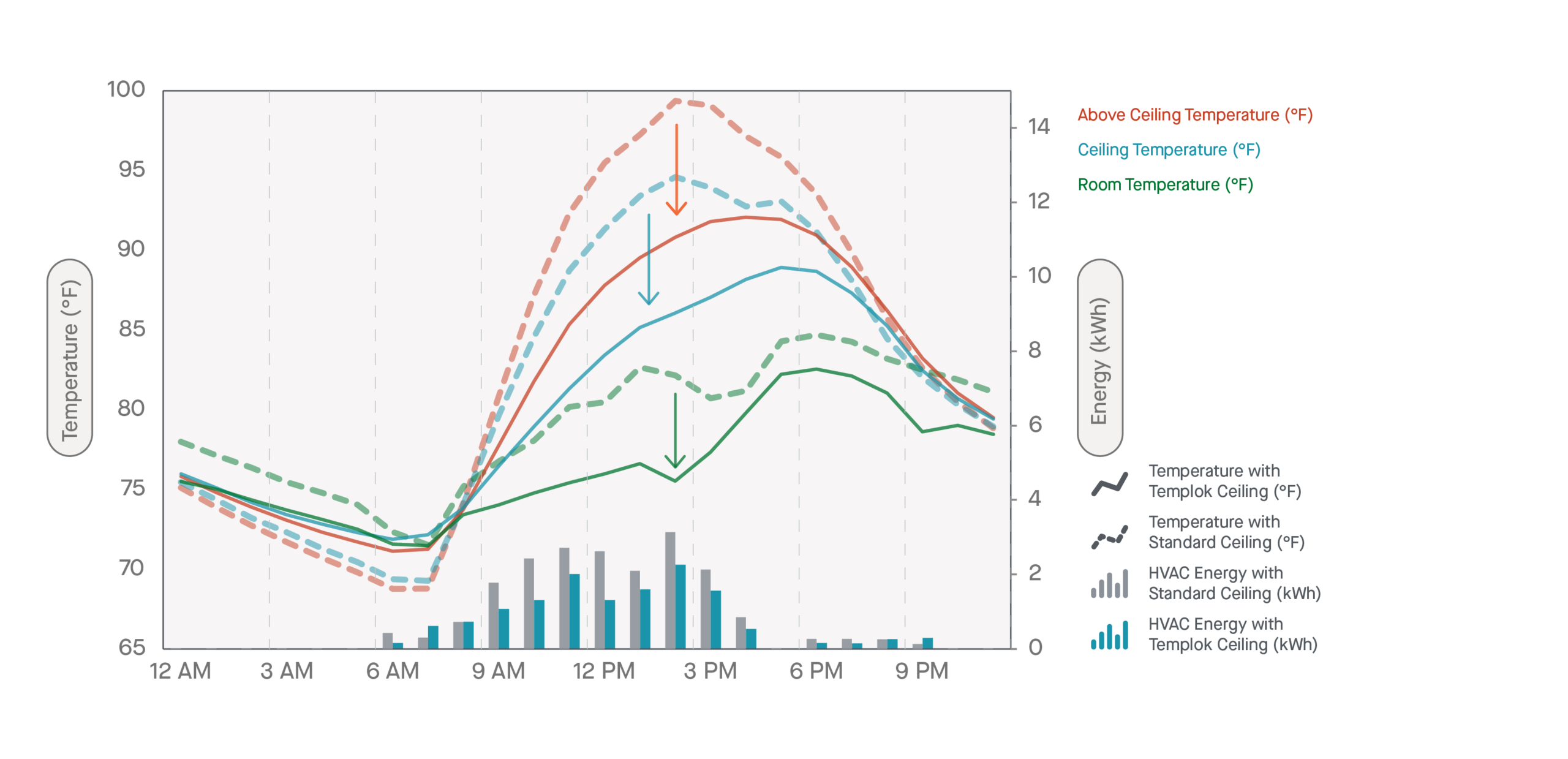
The benefits could go even further. If the temperature was modulated slightly to initiate the phase change when electricity prices are low or solar is prevalent, heat could be released/absorbed when needed or when electricity prices are high.
Beyond the energy savings, subsidies can make it less expensive than a traditional suspended ceiling. Because 45E tax credits can cover up to 50% of the total cost for the entire ceiling, including the grid, trim and labor, it can make the overall project significantly less expensive, despite the tiles themselves being somewhat more expensive.
A New Take On Old Technology With Future Potential
Phase change technology isn’t new. The handwarmers that you put in hot water to recharge and then click a metal disk to start the phase change work on a similar principle at higher temperatures. The melting ice in your cooler or the ice boxes of a century ago also work on a similar principle, but at lower temperatures.
Armstrong claims to have a proprietary material, but other options exist. Using different salts can adjust the temperature of the phase change. The solution needs to be suspended to prevent the salt crystals from precipitating out and concentrating at the bottom, but there are different ways to accomplish that. The phase change material needs to have adequate surface area to transfer heat, but that can take different forms.
This DIY video uses a combination of sodium sulphate with sodium chloride (table salt) to adjust the temperature where the phase change occurs, with xanthan gum to thicken the solution. All relatively inexpensive, available materials. High purity is not essential here.

That brings up a lot of potential applications. Could phase change pouches be added in the attics or crawl spaces of homes? Phase change materials for beds, pillows, blankets, seats, etc. to maintain a comfortable temperature for longer?
And we could also revisit the icebox with freezers integrating a block of “ice” with a modified freezing point. Or we could add phase change material to hot water heaters to let them store more heat and retain heat longer than the tank size would typically allow. We could even connect phase change material to coolant lines to form a connected thermal energy storage system.

A Technology That You Don’t Have To Think About, With Added Potential
One of the greatest benefits of the Templok ceiling tile system is that you don’t have to think about it. It does not look any different to people in the room. Acoustically, it performs just as well. It does not require any special installation or training. No complicated wiring or controls. Lower installation cost with tax credits — although, that would require a little paperwork. Lower energy costs happen as a result.
However, a little intelligence could amplify the effectiveness. In combination with a smart thermostat, the energy storage could be optimized. Intelligence could be applied to further optimize energy consumption to the specific building and use pattern. And the system could be combined with added thermal storage, battery storage, and renewable generation to further reduce energy consumption and shift loads.
Overall, thermal energy storage alone isn’t going to solve all of our energy challenges. But it is one tool with well-established, if underutilized, technology that can be implemented quickly. It will be interesting to see what other PCM thermal energy storage products are introduced in the coming years.
Sign up for CleanTechnica's Weekly Substack for Zach and Scott's in-depth analyses and high level summaries, sign up for our daily newsletter, and follow us on Google News!
Have a tip for CleanTechnica? Want to advertise? Want to suggest a guest for our CleanTech Talk podcast? Contact us here.
Sign up for our daily newsletter for 15 new cleantech stories a day. Or sign up for our weekly one on top stories of the week if daily is too frequent.

CleanTechnica uses affiliate links. See our policy here.
CleanTechnica's Comment Policy