


Support CleanTechnica's work through a Substack subscription or on Stripe.
The Red Lake School District in Minnesota has unveiled a new electric school bus fleet, making it the first public school district with an indigenous population to utilize funding from the EPA Clean School Bus Program. As the majority of US school districts wait a bit longer to make the transition to electrification, Red Lake is embracing cutting-edge energy solutions while honoring their roots.
Red Lake School District #38 partnered with Highland Electric Fleets, which provides school bus fleet Electrification-as-a-Service (EaaS) in North America. Highland Electric Fleets worked alongside the Red Lake School District on procurement to handle everything from securing funding to installing chargers.
As part of its mission, Highland brings healthier electric school buses to students and their community. The district’s new electric buses will help transport approximately 50 students each. With the necessary infrastructure in place, the electric buses can obtain an average range of 110 miles throughout the year with a full midday charge. The two buses are expected to travel a total of approximately 10,000 miles annually.
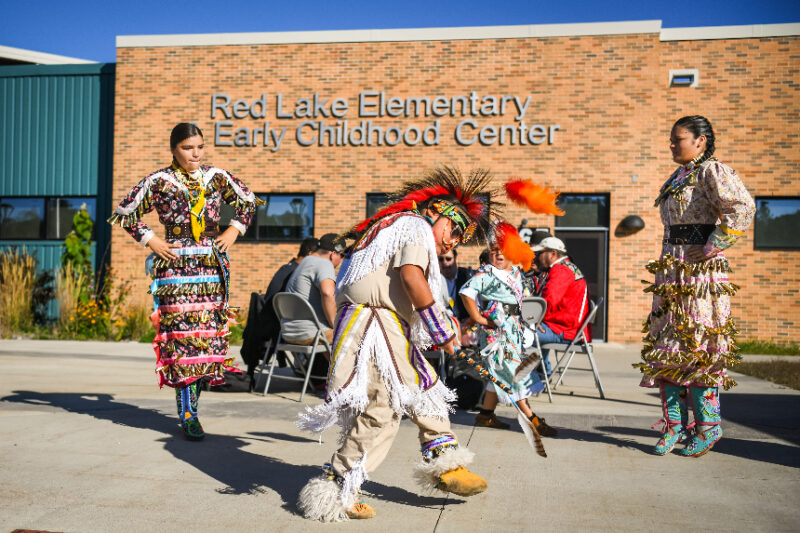
The District held a ribbon-cutting ceremony to launch the new buses at Red Lake Elementary School which included Ojibwe traditions, keynote speakers from Red Lake Nation, the district, government officials, and a student from Red Lake. Afterward, attendees were invited to take short rides on one of the new electric buses.
This initiative underscores the district’s commitment to energy transformation, in tandem with honoring its cultural heritage. Red Lake’s student body is 99.8% Native American and its curriculum strongly emphasizes Ojibwe heritage, language, and customs as they usher in the latest in sustainable transportation technology.
“It’s an honor to work alongside Red Lake School District #38, the only school district in the state of Minnesota located within a sovereign tribal nation, to provide healthier and cleaner transportation for students,” Highland Electric Fleets founder and CEO Duncan McIntyre told CleanTechnica. “This ribbon cutting symbolizes a powerful intersection of tradition and innovation, and marks an important milestone in our work to deliver safe and reliable electric school buses to a wide range of US school districts.”
Highland Electric Fleets offered the Red Lake School District its expertise as a leading provider of electrification-as-a-service for school districts, governments, and fleet operators in North America. Founded in 2019, Highland offers products that make it simple and affordable to upgrade to electric fleets. Active in 30 states and Canada, Highland is responsible for the first use of electric school buses in a commercial vehicle-to-grid (V2G) program and the largest electric school bus project in the US to date.
Red Lake Schools is located in northern Minnesota on the Red Lake Nation. The district covers approximately 1,014 square miles of land and water and serves the communities of Red Lake, Ponemah, Little Rock, and Redby. The District serves a student body with a mission to:
- cultivate each student’s respect for themselves, the culture of the Red Lake Nation, and the global community;
- offer an engaging and relevant academic curriculum with Anishinaabe language and culture; and,
- create a safe and positive learning environment and work together with students, parents, staff and community to provide all students with the tools and skills to achieve their full potential.
“As an educational institution, our priority is to provide learning opportunities for students and community members in as many ways as we can,” said Tim Lutz, Red Lake Schools Superintendent. “We achieve this goal through standardized curricula, but also through the utilization of best practices in energy utilization and sustainability, while also teaching students about future career opportunities in cutting-edge fields both on and from the Red Lake Nation. We are very proud of our efforts resulting in acquiring our two electric school buses, and we are confident the buses will serve us well.”

The Federal Clean Bus Program
The Bipartisan Infrastructure Law of 2021 authorizes the EPA to offer rebates to replace existing school buses with clean and zero-emission models. The Environmental Protection Agency (EPA) Clean School Bus Program (CSB) will provide $5 billion over five years (FY 2022-2026) to replace existing school buses with clean school bus models. School districts in all 50 states are eligible to apply for funding, which is provided through the Bipartisan Infrastructure Law. To date, over $2.8 billion has been awarded to 1,283 school districts, which will replace 8,725 school buses with electric school buses and clean school buses
The EPA CSB program first opened in 2022, and there have been three previous rounds of funding: one competitive grant round and two lottery rebate rounds.
Rounds 1 and 3 were lotteries with a relatively simple application process that each awarded a little under $1 billion in rebates. Round 2 was a competitive process with a complex application that also distributed a little less than $1 billion in grants.
Round 4 is a $965 million round that will fund up to 50 electric school buses per application. Priority applicants can request up to $325,000 per electric school bus, while non-priority applicants can request up to $170,000. Funds can be used to cover bus and infrastructure costs for awardees requesting electric school buses, as well as eligible training costs for bus drivers, electricians, and others working with the new buses or infrastructure.
Round 4 of the EPA CSB Program is now open as of September 26, 2024, with $965 million in funding available to support electric school buses and charging infrastructure in school districts. Applications are due by 4 p.m. EST on January 9, 2025.
Eligible New Replacement Criteria for the Electric School Bus Program
To be eligible as a replacement, new buses must:
- Have a battery-electric, CNG, or propane drivetrain.
- Biofuels will not be included as an eligible replacement technology for this funding opportunity.
- Be a new vehicle.
- Buses which have been converted to a battery-electric, propane, or CNG drivetrain after the first retail sale are not eligible for funding.
- The conversion of a bus to a battery-electric, propane, or CNG drivetrain is not eligible for funding.
- Be model year 2023 or newer.
- Have a Gross Vehicle Weight Rating (GVWR) of 10,001 lbs. or more.
- Be certified to conform with all applicable Federal Motor Vehicle Safety Standards (FMVSS).
- Be maintained, operated, insured, registered, and charged/fueled according to manufacturer recommendations and state requirements.
- Be equipped with an EPA certified engine if they are Propane or CNG fueled buses.
- Not be ordered prior to receiving official notification of selection for EPA funding.
- Be purchased, not leased or leased-to-own.
- Serve the school district listed on the application for at least five years from the date of delivery, unless the award is to an eligible contractor and the contract with the school district ends before the end of the 5-year period, in which case those school buses may service another local educational agency eligible for prioritization within the same state as the original local educational agency, if the school district listed on the application was eligible for priority consideration.
- If the original local educational agency was not eligible for prioritization, the new local educational agency still must be in the same state as the original local educational agency but is not required to be eligible for prioritization.
- Not be manufactured, retrofitted with, or otherwise have installed, a power unit or other technology that creates air pollution within the school bus, such as an unvented diesel passenger heater.
- Externally vented, fuel-operated passenger heaters are allowed; however, data shows that the emissions from auxiliary heaters are still harmful. The EPA strongly encourages applicants to consider alternative cold weather mitigation strategies (e.g., insulation of cabin and/or batteries, electric heat pumps, cabin and battery preconditioning) until other viable alternatives become available.
- Fuel-Fired Heaters are an allowable addition to replacement buses, but these heaters must be regularly maintained based on the recommended maintenance schedule of the fuel-fired heater manufacturer. The EPA may request maintenance records for fuel-fired heaters that have been installed in replacement buses. As such, replacement bus technicians should keep a maintenance log or equivalent of maintenance conducted on their fuel-fired heaters. See the Appendix of the Program Guide for an example maintenance schedule.
- Not be purchased or otherwise subsidized with other federal funds.
- The total CSB rebate award funds and other eligible external funds allocated for the bus replacement(s) cannot exceed the cost of the replacement bus(es).
- Upon request, be made available for inspection by the EPA or its authorized representatives for 5 years from the date of delivery to verify the buses are serving their intended purpose.
Sign up for CleanTechnica's Weekly Substack for Zach and Scott's in-depth analyses and high level summaries, sign up for our daily newsletter, and follow us on Google News!
Have a tip for CleanTechnica? Want to advertise? Want to suggest a guest for our CleanTech Talk podcast? Contact us here.
Sign up for our daily newsletter for 15 new cleantech stories a day. Or sign up for our weekly one on top stories of the week if daily is too frequent.

CleanTechnica uses affiliate links. See our policy here.
CleanTechnica's Comment Policy