


Support CleanTechnica's work through a Substack subscription or on Stripe.
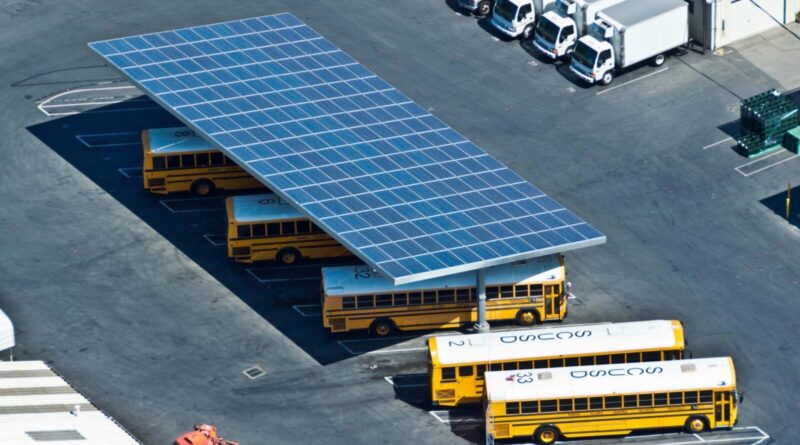
This technical note, describes the methods used to create a dataset of school bus depot locations in the United States. There are nearly half a million school buses in the country but almost no public information about where they are kept. Environmental justice literature describes how school bus depots may create air pollution hotspots for underserved communities that lead to health harms and may require grid infrastructure upgrades for future bus electrification.
Download Now
This Technical Note is part of WRI’s Electric School Bus Initiative within WRI Ross Center for Sustainable Cities.
This technical note describes the methods used to create a first-of-its-kind dataset of school bus depot locations in the United States. There are nearly half a million school buses in the country but almost no public information about where they are kept.
A large body of environmental justice and public heath literature describes how undesirable or dangerous facilities, such as truck depots and polluting industrial plants, are disproportionately located in or near communities of color, low-income communities, or populations that have been otherwise marginalized or underserved, leading to health harms. Research also describes the high levels of traffic-related air and noise pollution that is linked to health harms and inequitably distributed near many schools.
Therefore, a primary use case for this dataset is to analyze the extent to which school bus depots are located in underserved areas and to create an evidence base that would better enable the work of community members, advocates and other stakeholders toward improving air quality, equity, and public health in underserved areas. Other possible uses for this school bus depot dataset include electricity grid planning and resilience, given recent policy progress and other momentum toward school bus electrification. It could also be useful to identify school bus depots that are at risk from climate and other hazards and may not be strong candidates for large investments in electric infrastructure, and conversely to identify depots that could serve as resilience hubs.
We created this dataset using an object-based approach with remote sensing data. Our primary source of aerial imagery was the National Agriculture Imagery Program (NAIP) dataset. We analyzed NAIP imagery to locate individual school buses based on their color and size and then classified clusters of school buses as potential depots, which we then verified visually.
The resulting dataset contains 11,309 depots across the 48 contiguous U.S. states and Washington, DC. Fifty-one percent (5,730 depots) are at schools, defined as being 350 meters or less from the nearest school.
We assessed the accuracy of the dataset by comparing it with independent reference datasets containing 506 depots, from the records of two school transportation companies. We found good agreement, with an omission error rate of 15.2 percent (77 depots). This dataset represents one of the only remote sensing projects to conduct object detection using sub-meter to one-meter resolution data for a continental-scale application.
Key Findings:
- A total of 11,309 school bus depots across the 48 contiguous states of the United States and Washington, DC were identified.
- Fifty-one percent (5,730 depots) were located at schools, defined as being 350 meters or less from the nearest school.
- The number of depots varied significantly across states, likely correlated with factors such as the state’s population, population density, and the percentage of students that ride school buses.
- The median number of depots per state was 218.
- North Carolina had the most depots with 841.
- Texas and New York also had some of the highest numbers of depots, 697 and 618, respectively.
- South Dakota and Wyoming had only 29 depots each, likely due to low state populations and a high share of rural areas.
Collaborating to equitably electrify the U.S. school bus fleet. Authors: Yang Shao, Leah Lazer and Gregory Taff
Courtesy of WRI. Reach out to Brian Zepka for more information.
Sign up for CleanTechnica's Weekly Substack for Zach and Scott's in-depth analyses and high level summaries, sign up for our daily newsletter, and follow us on Google News!
Have a tip for CleanTechnica? Want to advertise? Want to suggest a guest for our CleanTech Talk podcast? Contact us here.
Sign up for our daily newsletter for 15 new cleantech stories a day. Or sign up for our weekly one on top stories of the week if daily is too frequent.

CleanTechnica uses affiliate links. See our policy here.
CleanTechnica's Comment Policy